12-Week REHS Exam Study Plan That Works
A week-by-week breakdown of the most effective study schedule, from diagnostic testing to final review, designed for full-time professionals.
Twelve weeks feels like plenty of time until you're three weeks in and realizing you've barely scratched Module 5. The difference between candidates who pass and those who don't often comes down to pacing, not raw intelligence. A well-structured 12-week REHS exam study plan distributes content logically across manageable chunks, prevents burnout, and leaves time for review and practice testing.
This isn't a generic study schedule. It's built around the 17 REHS modules, accounts for module difficulty variance, and front-loads diagnostic testing so you know exactly where to focus effort.
Why 12 weeks works, and why pacing matters
The REHS exam covers 17 modules spanning food safety, water quality, waste management, vector control, toxicology, and more. You can't cram this. You also can't afford to spend four weeks on Module 1 and then panic when you realize there are 16 others left.
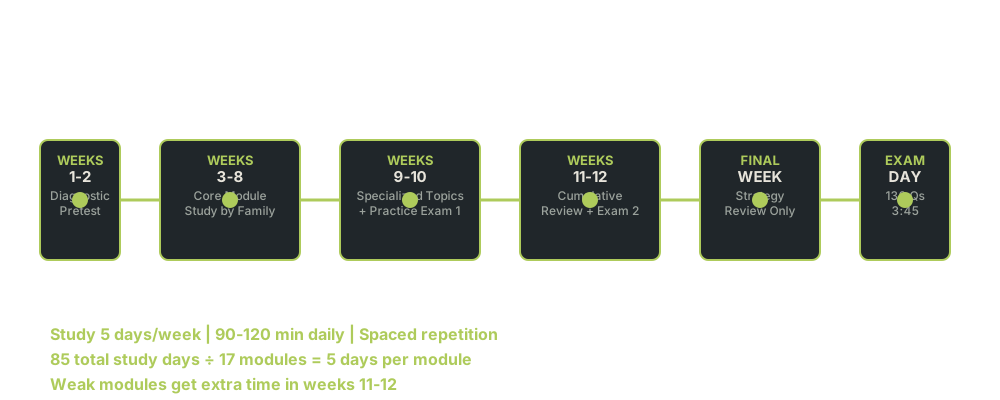
A 12-week plan distributed across 17 modules means roughly 5 days per module, with 2–3 weeks reserved for cumulative review and full-length practice testing. This timing allows for spaced repetition, the gold standard for retaining regulatory detail, without creating decision fatigue about what to study next.
17 modules × 5 days per module = 85 days of content study. Add 10–15 days for diagnostic testing and review. That leaves 5–8 days as buffer for slower modules or personal circumstances.
Weeks 1–2: Assess and establish foundation
Start with a diagnostic pretest covering all 17 modules. This isn't for a grade; it's to identify your weak spots. Spend 2–3 hours on a 40–50 question diagnostic, grade it by module, and note which areas feel weakest.
Then tackle the foundational modules: Module 1 (General Environmental Health, Statutes & Administration) and Module 17 (Epidemiology Concepts & Calculations). These set the regulatory and conceptual framework for everything that follows. Don't rush them.
Weeks 3–8: Content deep work by module family
Group modules by conceptual similarity to build momentum and avoid context-switching burnout.
- Weeks 3–4: Modules 2–3 (Food Protection, Disease & Foodborne Illness)
- Weeks 5–6: Modules 5–6 (Drinking Water, Wastewater)
- Weeks 7–8: Modules 7–9 (Solid Waste, Hazmat, Medical Waste)
For each module, spend one day on core concepts and regulatory citations. Spend the next days on knowledge checks, scenario questions, and memory aids. Don't move to the next module until you score 75% or higher on that module's knowledge check.
Weeks 9–10: Specialized content and practice testing
Modules 10–14 (Recreational Health, Housing, Vector Control, Air Quality, Radiation) vary widely in difficulty. Some candidates breeze through pools and spas; others struggle with vector control entomology. Weeks 9–10 let you allocate time based on your diagnostic results and personal weak spots.
Start a full-length practice exam (100 questions) in week 9. Don't aim for a perfect score. Aim to identify patterns in what you're missing. Are you struggling with a specific module? Certain question types? Pacing?
Take the first practice exam under untimed conditions. Review every single missed question, and don't stop at the right answer; figure out why the wrong one was wrong. Then take a second practice exam with time limits.
Weeks 11–12: Cumulative review and final prep
The final two weeks shift from learning to mastery. Review modules that still feel shaky. Focus on high-frequency questions and regulatory details you've seen appear across multiple modules.
Take a cumulative practice exam in week 11. Grade it carefully. Review missed questions. In week 12, focus on weak modules, take a final full-length exam (timed, realistic conditions), and spend your last few days on the exam-day strategy and logistics.
Most test anxiety comes from uncertainty about the format or logistics, not the content. You already know this material. Spend your final week confirming that you know the test-day playbook.
Managing life around your study plan
This schedule assumes 90–120 minutes of focused study daily, five days a week. That's realistic for working professionals. Here's how to protect that time:
- Block it on your calendar like a meeting you can't skip.
- Study at the same time each day when possible. Your brain adapts to routine.
- Use weekends for practice testing and module review, not rushed cramming.
- If you miss two days, adjust forward by two days rather than trying to "make up" study that night.
The bottom line
A 12-week plan isn't rigid. It's a framework. If Module 8 (Hazmat) takes you longer than expected, shift the schedule forward. If you nail Module 14 in three days, use the extra day for weak spots elsewhere. The structure keeps you on track. Flexibility keeps you sane.
Ready to start studying?
Three free companion PDFs unlock with your email: diagnostic pretest, flashcards, and the exam-day guide.
Unlock the free PDFsOr try the free practice quiz, 25 questions with instant feedback, no purchase required.