After You Pass: REHS Renewal & CE Guide
What happens after you pass the REHS exam: Registration process, biennial renewal, CE requirements, and maintaining active status.
You passed the REHS exam. Congratulations. But the exam isn't the end; it's the beginning. Now you need to actually register, maintain your credential, and understand what it means to stay active as an REHS professional.
The post-exam process is straightforward but has deadlines and requirements you need to know about.
Immediately after passing: Your score report
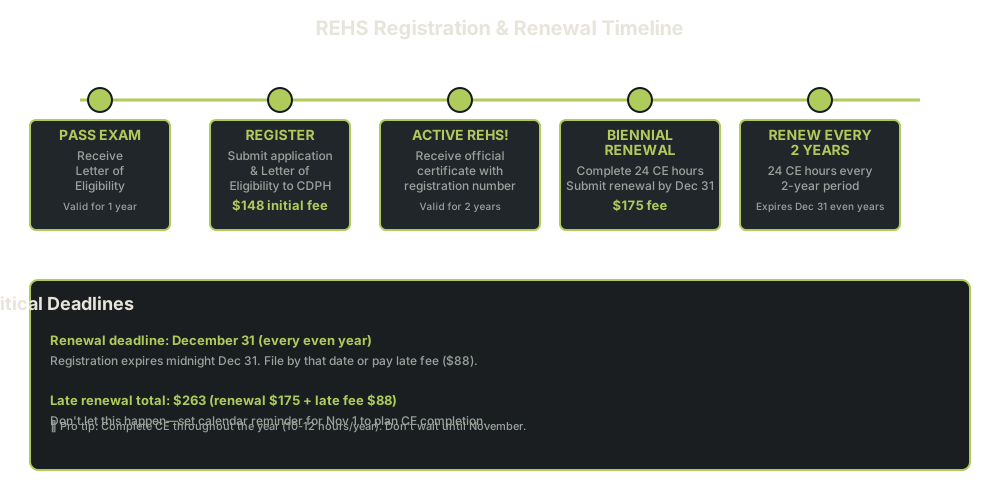
You'll receive a pass/fail result immediately at the testing center. Passing means you're eligible to register, but it doesn't make you a registered REHS automatically. You still need to formally submit your registration application, with the initial registration fee, to the California Department of Public Health. Note that "Letter of Eligibility" specifically refers to the letter CDPH issues earlier in the process, after your transcripts are evaluated, confirming you can work as an EHS Trainee. It's a separate document from anything issued at this exam-passing stage, so don't confuse the two if you see the term used elsewhere.
Don't sit on a passing result. We don't have a verified, current source for exactly how long your eligibility to register stays open after you pass, so confirm the specific deadline with CDPH rather than trusting a number from any prep site. Whatever the window is, treat registration as something to process soon after passing, not something to put off.
The registration process
To register as an REHS, you need to complete an application with the California Department of Public Health Environmental Health Specialist Registration Program. The application requires:
- Proof that you passed the REHS exam
- Proof of employment in an environmental health position (or proof that you work in a position requiring REHS registration)
- The registration application form (available from CDPH)
- The initial registration fee
Mail your application and fee to the REHS Program office in Sacramento. Processing typically takes 2–4 weeks. Once approved, you'll receive your official REHS certificate with your registration number. You are now a Registered Environmental Health Specialist and can legally use the title "REHS."
Registration fees and cost
Initial registration with CDPH costs $327 for an active REHS registration. This is a one-time fee, not an annual charge. After you register, you'll pay biennial renewal fees, not ongoing application fees.
If you later become retired or inactive (not working in an REHS position), you can maintain a retired status for just $25 biennially, provided you've worked as an REHS for at least 10 years, are at least 50 years old, or are collecting retirement benefits.
Biennial renewal: Your ongoing obligation
REHS registration is biennial, meaning you renew every two years. Your registration expires on December 31st of even-numbered years. You must submit your renewal application and fee by that date to maintain active status.
The biennial renewal fee for an active REHS is $327. If you miss the renewal deadline, you'll pay a late fee of $163 (total $490). Renewal must be postmarked by December 31st. Don't rely on delivery time.
Continuing education: The real requirement
To renew your registration, you must complete 24 contact hours of approved continuing education during the two-year period. This is the substantial requirement, more important than the fee.
What counts as approved CE:
- Courses offered by approved Accreditation Agencies (AAs) for REHS
- University courses (1 semester unit = 15 contact hours; 1 quarter unit = 10 contact hours)
- Webinars, workshops, conferences approved by AAs
- Not all training counts: it must be from an approved provider and relevant to environmental health
A "contact hour" is 50–60 minutes of instruction. So 24 contact hours is roughly 20–24 hours of actual classroom or workshop time over two years. That's about 10–12 hours per year, or 1 hour per month. Manageable if you're proactive.
Don't wait until December to complete your CE hours. Spread them throughout the year. Many employers cover CE costs and time. Take advantage if your organization does.
Finding approved CE courses
The REHS website (CDPH) maintains a list of approved Accreditation Agencies. These agencies approve CE providers and courses. You can search their websites to find courses, conferences, and webinars that count toward your 24-hour requirement.
Options include:
- California Environmental Health Association conferences and workshops
- Local health department training programs (if approved)
- University extension courses
- Online webinars from approved providers
- Industry-specific conferences (food safety, water quality, hazmat)
When you take a course, ask for a certificate of completion showing the contact hours. Keep these documents. When you renew, you'll submit proof of your CE hours.
What happens if you don't renew on time?
Your registration expires December 31st of the even year. If you don't renew by that date, your REHS credential becomes inactive. You cannot legally use the title "REHS" or perform work that requires REHS registration.
You can still renew late (with a late fee) if you do so within a reasonable timeframe. But employers may not allow you to work in REHS-requiring positions if you're not actively registered. Don't let this happen. Set a calendar reminder for November 1st to start your renewal process.
Maintaining active status long-term
After your initial registration, being an REHS requires:
- Completing 24 contact hours of approved CE every two years
- Submitting your renewal application and fee by December 31st
- Maintaining a job that requires REHS registration (if you're in active status)
Most REHS professionals work for local health departments, state agencies, or in food safety/environmental consulting. Your employer usually tracks CE requirements and may help cover costs. If you change jobs, make sure your new employer understands that you need to maintain CE and renewal timelines.
The bottom line
Passing the REHS exam is a major achievement, but it's the gateway, not the destination. After you pass, register promptly, pay your biennial renewal on time, and complete your continuing education. These aren't bureaucratic obstacles. They exist because environmental health evolves constantly. Your CE ensures you stay current with regulatory changes, new research, and emerging environmental threats. Stay registered, stay current, and you have a credential that's nationally recognized and professionally valuable for decades.
Ready to start studying?
Three free companion PDFs unlock with your email: diagnostic pretest, flashcards, and the exam-day guide.
Unlock the free PDFs