REHS Exam Anxiety: How to Stay Confident
Practical strategies to manage test anxiety before and during the REHS exam. Normalize stress and build confidence.
Test anxiety on the REHS exam is normal. Even strong candidates feel it. Your heart rate rises, your mind goes blank, you second-guess answers you know are correct. The difference between candidates who pass and those who don't often comes down to how they handle these moments, not whether they experience them at all.
Anxiety isn't a sign you're unprepared. It's a sign you care about the outcome. The goal isn't to eliminate anxiety. That's impossible and unnecessary. The goal is to recognize it, understand what's triggering it, and have tools to move through it.
Why test anxiety happens
Your brain is designed to protect you from threats. An exam feels like a threat: it's high-stakes, time-limited, and you can't control the outcome. Your nervous system responds by releasing adrenaline and cortisol. Your heart rate rises. Your hands shake. Your mind narrows.
In small doses, this is helpful. Adrenaline sharpens focus. Cortisol activates memory. But too much anxiety overwhelms your working memory and pushes you toward panic.
Test anxiety and competence are independent. You can be highly prepared and still feel anxious. You can be less prepared and feel calm. Anxiety tells you nothing about whether you'll pass.
Anxiety before exam day
In the final week: Shift from content to strategy
If you're one week out and still cramming content, anxiety will spike. You can't finish everything. Your brain knows it. Instead, shift your focus entirely to test-day strategy, logistics, and confidence-building. Review the exam-day tactics. Know your plan. This reduces the "unknown threat" that your nervous system is reacting to.
Two days before: Stop studying
This isn't laziness. Your brain needs rest. Cramming creates fatigue and anxiety without improving performance. Two days before the exam, stop adding new information. Move to light review only. Let your body recover.
The night before: Preparation ritual
Lay out what you'll bring. Confirm your route. Set alarms. Eat well. Go to bed on time. These rituals reduce anxiety by replacing uncertainty with action. You're not worrying about forgetting something; you've already prepared.
Morning of: Anchor yourself
Eat a solid breakfast. Shower. Do something that makes you feel human. Avoid checking your study notes. It triggers panic. Arrive 30 minutes early to the testing center. Use that time to sit quietly, breathe, and remind yourself: "I've prepared. I know this material. I'm ready."
Preparation reduces anxiety more than affirmations do. You can't talk yourself calm. But you can remind yourself that you've done the work.
Managing anxiety during the exam
The first hard question
You'll hit a question you don't know. Your anxiety spikes. Your instinct is to dwell on it. Don't. Mark it and move forward. Every question you struggle with early tells you nothing about the rest of the exam. You still have most of the booklet ahead of you, plus a second booklet after it. One hard question is noise.
Physical grounding when panic rises
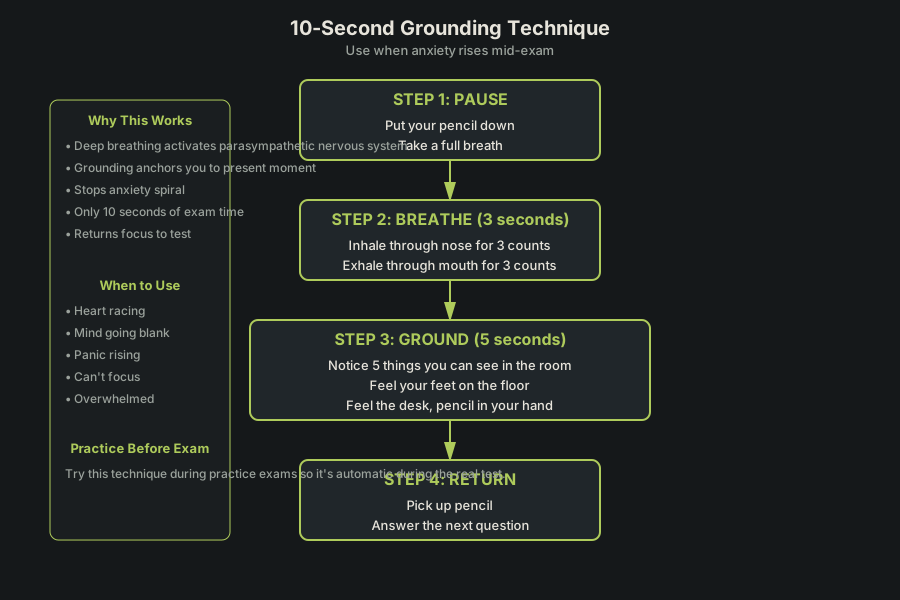
If you feel your mind racing or panic building mid-exam:
- Put your pencil down. Pause for 10 seconds.
- Take three slow, deep breaths, in through your nose and out through your mouth.
- Notice five things you can see in the room. Ground yourself in the present.
- Pick up your pencil and answer the next question.
This isn't magic. It's physiology. Deep breathing activates your parasympathetic nervous system, the "calm down" system. It works even if it feels silly.
When you hit a section that feels unfamiliar
You're 60 questions in. You hit questions on a module you're less strong in. Your anxiety rises. This is expected. Every candidate hits a weak module mid-exam. Acknowledge it: "I knew this module was shaky. I'm going to do my best and move on." Then do exactly that. Don't let one module's difficulty color the rest of your performance.
What anxiety is actually telling you
Anxiety isn't always a problem signal. Sometimes it's your nervous system doing its job, keeping you alert and engaged. The issue arises when anxiety becomes overwhelming and paralyzes your thinking.
If you feel nervous but focused, that's fine. You're appropriately alert. If you feel panicked and can't think clearly, use the grounding techniques above. The distinction matters: nervous energy is useful. Panic isn't. Learn to tell them apart.
After the exam: The hardest part
You submit your exam. Your mind immediately replays every question you struggled with. You convince yourself you failed. This is normal. Your brain is running worst-case scenarios because the outcome is now uncertain.
Accept this. You can't change your score anymore. You did your best with what you knew. That has to be enough. Resist the urge to discuss the exam with others: you'll spiral into "I said X but the answer was Y" second-guessing.
Instead: Do something completely unrelated. Go for a walk. Have dinner. See a movie. Give your brain permission to move on. When your results come back, you'll either pass and celebrate, or you'll have specific feedback for the retake. Both are manageable.
The bottom line
Test anxiety is part of the process, not a sign of failure. The candidates who pass aren't the ones who don't feel anxiety. They're the ones who feel it and move forward anyway. You can't control whether anxiety shows up. You can control how you respond when it does.
Ready to start studying?
Three free companion PDFs unlock with your email: diagnostic pretest, flashcards, and the exam-day guide.
Unlock the free PDFs