The History of REHS in California
How California's environmental health profession went from an unregulated trade in 1945 to a licensed, 17-module credential today.
The REHS exam exists because of a decision made 80 years ago. Understanding where this profession came from helps explain why the exam covers what it covers, why the 17 modules exist, and why California's environmental health standards are among the most rigorous in the nation.
In 1945, California created the first credential for this kind of work. In 1988, a name change caught up to a job that had already outgrown its original scope.
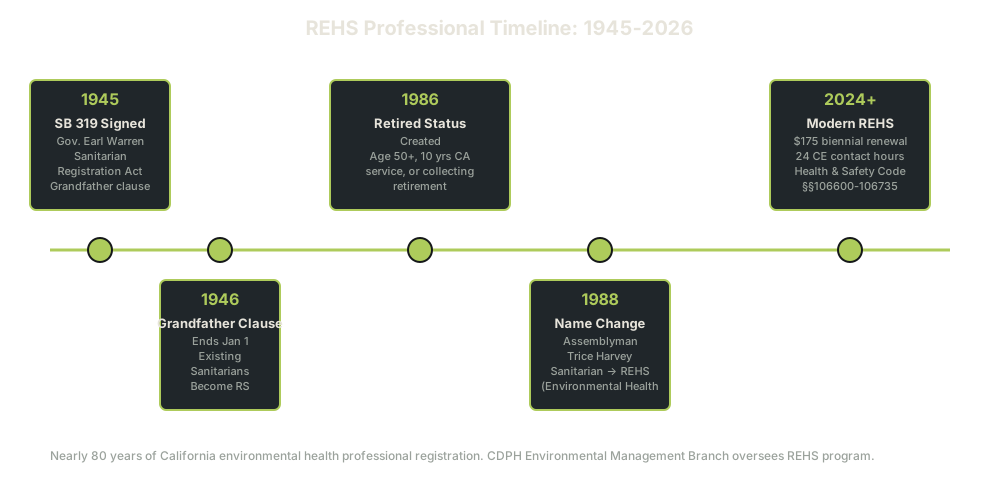
1945: The birth of the Sanitarian Registration Act
Senate Bill 319 (SB 319), signed by Governor Earl Warren, created the first registration program for Sanitarians in 1945. At the time, California's food and housing inspectors, called Sanitarians, had no formal credential or standardized expertise. The state legislature recognized the need to professionalize the field.
The original "Sanitarian" was defined as "a person trained in the field of sanitary science and technology who is qualified to carry out educational and inspectional duties and enforce the law in the field of sanitation." The focus was narrow: food safety, waste disposal, housing conditions, and basic public health hazards.
Anyone who was classified as a Sanitarian prior to January 1, 1946 automatically became a Registered Sanitarian (RS). The California Department of Public Health was then directed to develop criteria and a comprehensive examination to test minimal knowledge in the profession.
The Sanitarian Registration Act made it illegal to claim the title without meeting state standards, and several other states later used it as a model for their own registration programs.
The post-war expansion: 1945–1980s
In the decades following 1945, the profession expanded dramatically. The Cold War brought new environmental concerns: industrial pollution, nuclear testing impacts, hazardous chemicals. The 1970s saw the birth of the EPA and unprecedented environmental regulation. California's sanitarians found themselves managing water quality, air pollution, hazardous waste, and radiation exposure on top of their original food and housing duties.
The profession was changing faster than the title acknowledged. By 1975, a registered sanitarian's job looked nothing like the 1945 original: testing drinking water for contamination, investigating disease outbreaks, managing hazardous materials, and enforcing an expanding set of environmental regulations.
The term "sanitarian" no longer fit. Worse, the public perception of the word was becoming a liability. Too often, people confused "sanitarian" with "sanitation worker" or janitor. The profession needed a rebrand that reflected its scope and expertise.
1986: The first amendment, preparing for retirement
In 1986, the California legislature amended the Sanitarian Registration Act to create a new classification: retired sanitarians could renew their registration at a reduced fee of $25 (rather than the full biennial renewal fee). This change, effective January 1, 1987, recognized the profession's maturity and allowed experienced practitioners to maintain their credentials in retirement.
To qualify for retired status, sanitarians had to be at least 50 years old or collecting retirement benefits, have worked as a Registered Sanitarian for at least 10 years in California, or have received an on-the-job disability before the 10-year requirement elapsed. This classification remains in effect today.
1988: The name change that transformed a profession
Two years later came the transformation. Assemblyman Trice Harvey carried legislation in 1988 that changed the official title from "Registered Sanitarian" (RS) to "Registered Environmental Health Specialist" (REHS). This was done with the support of the California Environmental Health Association to reflect that the job had grown well past sanitation into the broader field of environmental health.
The name change was more than cosmetic. It reflected a fundamental shift in what the profession had become:
- Inspections expanded from food and housing into full environmental management.
- The required science grew from basic sanitation into toxicology, epidemiology, and hazardous materials.
- Enforcement authority extended from local jurisdictions to state and regional environmental protection.
- A single professional identity split into specialties: water, air quality, disease investigation, and industrial health.
The public had long confused "sanitarian" with sanitation or janitorial work, and the new title fixed that. The profession now had a title that accurately reflected its expertise and scope.
The 1988 name change reflected something real: environmental health had moved from inspection work to applied science.
1990s–2000s: Modernization and specialization
After the 1988 name change, the REHS program underwent continuous modernization. The exam content expanded to reflect new environmental challenges: vector control, medical waste management, body art facilities, disaster response. Universities began offering dedicated degrees in environmental health, creating a more educated workforce.
CDPH added a biennial continuing education requirement so REHS professionals kept up with regulatory changes. The 17-module exam structure emerged around this time, covering food safety, water, air, waste, toxicology, epidemiology, and several other specialized sectors.
Today: A mature, nationally recognized credential
The Environmental Health Specialist Registration Program is regulated by California Health and Safety Code Sections 106600-106735 and is administered by the Environmental Management Branch of CDPH. The program's mission remains what it was in 1945: to ensure that persons who perform environmental health work meet prescribed standards of education, training, and experience.
Today's REHS credential is nationally recognized. The exam reflects 80 years of evolution in the profession. The 17 modules test knowledge that didn't exist when the program began: toxicology dose calculations, vector-borne disease epidemiology, hazardous materials management, body art infection control. The purpose hasn't changed since 1945: making sure the people doing this work are actually qualified to do it.
Why this history matters to you
Understanding where the REHS program came from helps explain what the exam tests. The topics aren't random. Each module exists because the profession had to expand into that area at some point. Food safety appears heavily because that's where the profession began. Water quality is central because it became critical in the 1970s. Hazardous materials dominate because modern environmental health is about managing complex chemical and biological risks.
That's 80 years of accumulated practice behind each module you study, not an arbitrary list of rules to memorize.
The bottom line
The job has changed enormously since 1945, when Sanitarians mostly inspected outhouses and food stands. The 1988 name change caught the title up to what the work had already become. Today's REHS credential reflects scientific expertise, regulatory knowledge, and professional judgment built up over eight decades. That's the context behind the exam you're studying for.
Ready to start studying?
Three free companion PDFs unlock with your email: diagnostic pretest, flashcards, and the exam-day guide.
Unlock the free PDFs