REHS Exam Format, Length & Question Types
Everything you need to know about the REHS exam structure, timing, question formats, passing score, and how it's actually scored.
The REHS exam intimidates many candidates simply because they don't know what to expect. Walk into the testing center with a clear picture of the format and you've already won half the psychological battle. Knowing the structure, time limits, question types, and scoring rubric lets you allocate your energy strategically and avoid surprises mid-exam.
Here's what you're actually facing on exam day.
The basic facts: Length and structure
The REHS exam contains 260 multiple-choice questions across 17 modules, administered as two separate 130-question booklets rather than one continuous test. Several sites, including an earlier version of this article, describe the exam as "approximately 130 questions." That's one booklet, not the whole exam. CDPH's own Model Training Plan and REHS Study Guide are explicit on this point: 260 questions total, split into two booklets of 130 each.
The exam is offered three times a year, in March, July, and November, at sites in Sacramento and the Santa Ana area. We don't have a confirmed, current source for the exact time limit CDPH allots per booklet or in total, so don't take a specific number from any prep site (including this one, previously) as gospel. Your official exam admission materials from CDPH will state the actual time limit for your test date. Treat that as the source of truth, and budget your practice-exam pacing around it once you have it.
The exam is administered at a testing center, similar to other professional licensing exams. You'll use a computer to answer questions. The testing software is straightforward: read a question, select from four answer choices, move to the next question. No essays, no fill-in-the-blank, no special formatting tricks.
You can't skip questions and come back to them later on most versions of the exam. Read carefully the first time. If you're uncertain, make your best guess and move on. You can flag questions for internal note-taking but can't change answers after submission.
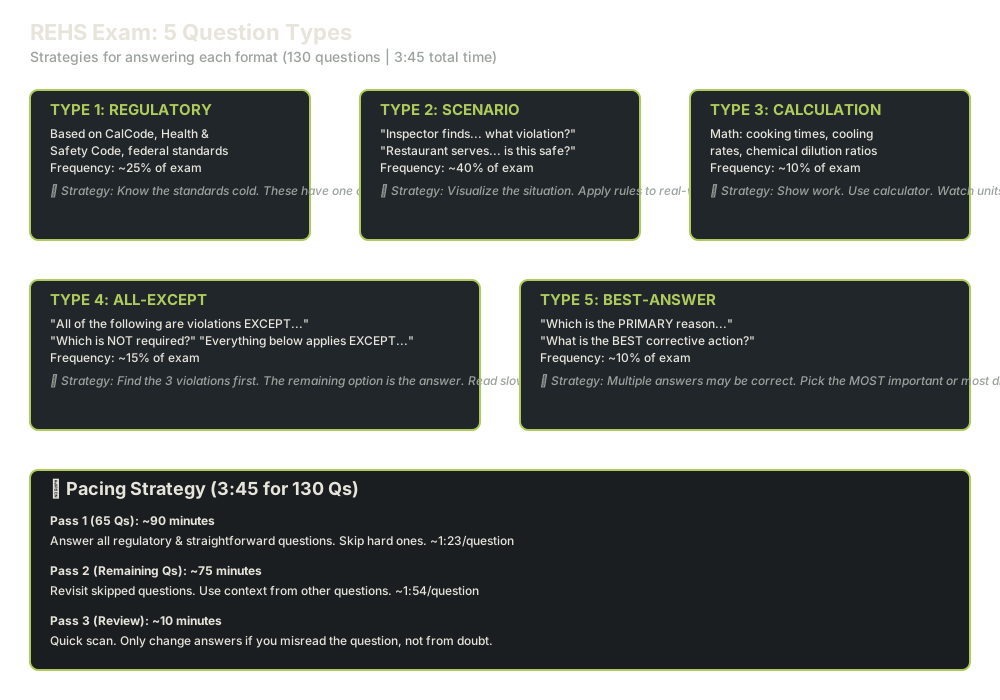
What question types do you see?
Straight regulatory questions
These test your knowledge of specific regulations, standards, and numerical thresholds. Example: "What is the maximum free chlorine residual in a swimming pool according to California standards?" You either know it or you don't.
Scenario-based questions
These describe a real situation and ask what action you should take, what regulation applies, or what violation has occurred. They require you to apply knowledge to a practical situation. Example: "A restaurant failed a food safety inspection. The inspector found raw chicken stored above ready-to-eat foods. Which violation code applies, and what corrective action is required?"
Calculation questions
Mostly in modules covering pools, epidemiology, and water quality. You're given data and asked to calculate an attack rate, pool turnover time, chlorine dosage, or similar metric. Calculators are typically not allowed; expect simple arithmetic that tests formula knowledge rather than computational complexity.
"All of the following except" or "Which is NOT required" questions
These reverse the logic. Three answers are correct; one is wrong. Or three are true; one doesn't meet the requirement. Read the question stem carefully. Circle the negation word mentally.
Best-answer questions
Multiple answers might technically be correct, but one is more correct given the regulatory context or specificity required. These test your understanding of nuance more than your ability to recall a definition.
You won't see creative question types or curveballs. The REHS exam tests your ability to recall regulations, apply them to scenarios, and do straightforward calculations. Straightforward doesn't mean easy, but it means no tricks.
How is the exam weighted across modules?
The exam doesn't weight all modules equally, but the exam board doesn't publicly release exact weightings. Based on test-taker experience and job analysis data, modules like Food Protection (Module 2), Water Quality (Module 5), and Disease Control (Module 3) appear more heavily tested than specialized modules like Body Art Facilities (Module 16) or Dairy Science (Module 4).
Expect roughly 14–20 questions per major module and 6–10 per specialized module across the full 260-question exam. This is a rough estimate, not a guarantee.
What's the passing score?
CDPH doesn't use a single fixed passing number that's the same on every exam form. Per CDPH's own Pass Point Determination methodology, the department sets a pass point for each version of the exam using a modified Angoff method: subject matter experts rate how a minimally competent, entry-level REHS would perform on each question, and the pass point is calculated from those ratings rather than graded on a curve against other candidates. In practice, published pass points for REHS registration exams typically fall in the 60–70% range of items answered correctly, and that range shifts slightly from form to form depending on that form's difficulty.
The practical upshot is the same either way: you don't need a perfect score, and you don't need to know the exact cutoff to prepare well. Missing a meaningful chunk of questions is still compatible with passing if you're getting the right ones right.
Missing questions is normal and expected. Even candidates who pass miss questions in areas they don't work with daily. Focus on reducing careless errors, not achieving perfection.
How long does each booklet actually take?
The exam is two 130-question booklets, not one continuous 130-question test. We don't have a verified, current source for the exact per-booklet time allotment, so we're not going to publish a specific minute-by-minute pacing table built on a number we can't confirm. What we can tell you: budget your practice-exam pacing around your actual admission materials once CDPH sends them, not around a generic pacing chart from a prep site.
In the meantime, the general pacing principles still hold across both booklets:
- Don't burn disproportionate time on your first few questions while you're still settling in.
- If a question stalls you for more than a minute or two, mark your best guess and move on. You cannot get every question right, and one hard question early on tells you nothing about the rest of the booklet.
- Save a few minutes at the end of each booklet, if your time allows, for a final check rather than spending it all pushing through new questions.
These aren't hard rules, but they reflect sound pacing regardless of the exact time limit.
Can you use a calculator? Other materials?
Most testing centers allow a basic calculator (no graphing, no advanced functions). You'll have scratch paper for notes during the exam. You cannot bring study materials into the testing room.
What happens after you submit?
You'll get an immediate pass/fail result at the testing center. You don't get detailed feedback on individual question performance. If you pass, you're licensed. If you don't pass, AB 1288 (effective January 1, 2026) set a 90-day waiting period before you can retake the exam, replacing the older twice-then-wait rule, so confirm the current process with CDPH before you plan your retake.
The bottom line
The REHS exam is a straightforward test of regulatory knowledge, practical application, and basic calculation, delivered as two 130-question booklets rather than one. No gotchas, no tricks, no surprises in question style. It's timed but not brutally so if you pace yourself against your actual admission materials. Knowing exactly what to expect removes uncertainty and lets you focus on what you actually need: mastery of the 17 modules and the ability to apply that knowledge under time pressure.
Ready to start studying?
Three free companion PDFs unlock with your email: diagnostic pretest, flashcards, and the exam-day guide.
Unlock the free PDFsOr try the free practice quiz, 25 questions with instant feedback, no purchase required.